The following was sparked by this blog post from Col Beer titled: "Is it time to reignite the argument around shadow systems?"...more...

Finally, a reasonable version of Canvas Collections and associated support materials is ready to announce. Following will eventually form the content of a blog post posted to the Canvas community space....more...
Contemporary higher education appears to have a scale problem....more...

Henry Cook, Steven Booten and I gave the following presentation at the THETA conference in Brisbane in April 2023....more...

This work arose from the depths of an institutional LMS migration (Blackboard Learn to Canvas). In particular, the observation that the default migration processes required an awful lot of low level manual labour. Methods that appeared to reduce the quality of the migration process and increase the cost. Hence we started developing different methods. As the migration project unfolded we kept developing and refining. Building on what we'd done before and further decreasing the cost of migration, increasing the quality of the end result, and increasing the scale and diversity of what we could migrate....more...

All university strategies for learning and teaching seek to maximise: accessibility (as many people as possible can participate - feel the scale - in as many ways as possible); quality (it's good); and, cost effectiveness (it's cheap to produce and offer). Ryan et al (2021) argue that this is a "key issue for contemporary higher education" (p. 1383) due to inevitable cost constraints, the benefits of increased access to higher education, and requirements to maintain quality standards. However, the literature on the "iron triangle" in higher education (e.g. Daniel et al, 2009; Mulder, 2013; Ryan et al, 2021) suggests that maximising all three is difficult, if not impossible. As illustrated in Figure 1 (adapted from Mulder, 2013, p. 100) the iron triangle suggests that changes in one (e.g. changing accessibility from on-campus to online due to COVID) will have negatively impact at least one, but probably both, of the other qualities (e.g. the COVID response involving increase in workload for staff and resulting in less than happy participants)....more...
The following illustrates how the game Number Scrabble and Herb Simon's thoughts on the importance of design representation appears likely to help with migration of 1000s of course sites from Blackboard Learn (aka Blackboard Original) to another LMS. Not to mention becoming useful post-migration....more...
Pre-COVID the role of technology in learning and teaching in higher education was important. However, in 2020 it became core as part of the COVID response. Given the circumstances it is no surprise that chunks of that response were not that great. There was some good work. There was a lot of a "good enough for the situation" work. There was quite a bit that really sucked. For example,...more...

The following is sparked by Twitter conversations arising from a tweet from @neilmosley5 quoting from this article by Tony Bates. In particular, pondering a tweet from @gamerlearner where the idea is that a "consistent requirement for educators in HE to have some kind of formal teaching qual" will not only help motivate academics "to take time out to learn how to teach better" and generally value teaching more....more...

In late 2018 I started work at an institution using Blackboard Learn. My first project helping "put online" a group of 7 courses highlighted just how ugly Blackboard sites could be and how hard it was to do anything about it. By January 2019 I shared the solution I'd developed - the Card Interface. Below is a before/after image illustrating how the Card Interface 'tweaks' a standard Blackboard Learn content area into something more visual and contemporary. To do this you add some provided Javascript to the page and then add some card meta data to the other items....more...

In learning what matters most is what the learner does. As people looking to help people learn we can't make them learn. The best we can do is to create learning situations - see Goodyear, Carvalho & Yeoman (2021) for why I'm using situation and not environment. We design the task, the learning space and social organisation (alone, pairs, groups etc.) that make up the situation in which they will engage in some activity. Hopefully activity that will lead to the learning outcomes we had in mind when designing the situation....more...

On October 30 I watched a webinar (recording below) given by Joyce Seitzinger (@catspyjamasnz) and hosted by the Commonwealth of Learning. It was titled, "How Learning Design Systems can help scale and accelerate learning design". If you work in higher education helping with the practice of digital (or post-digital education) - which is a bigger group of folk than it was 12 months ago - then I recommend the talk and the approach. Especially, if you're having to deal with scale - large student numbers, large numbers of courses, multiple offerings etc....more...

It's widely accepted that the most important part of learning and teaching is what the student does (Biggs, 2012). The spaces, tools and tasks in and through which students "do stuff" (i.e. learning, or not) are in some way designed by a teacher with subsequent learner adaptation (Goodyear, 2020)....more...
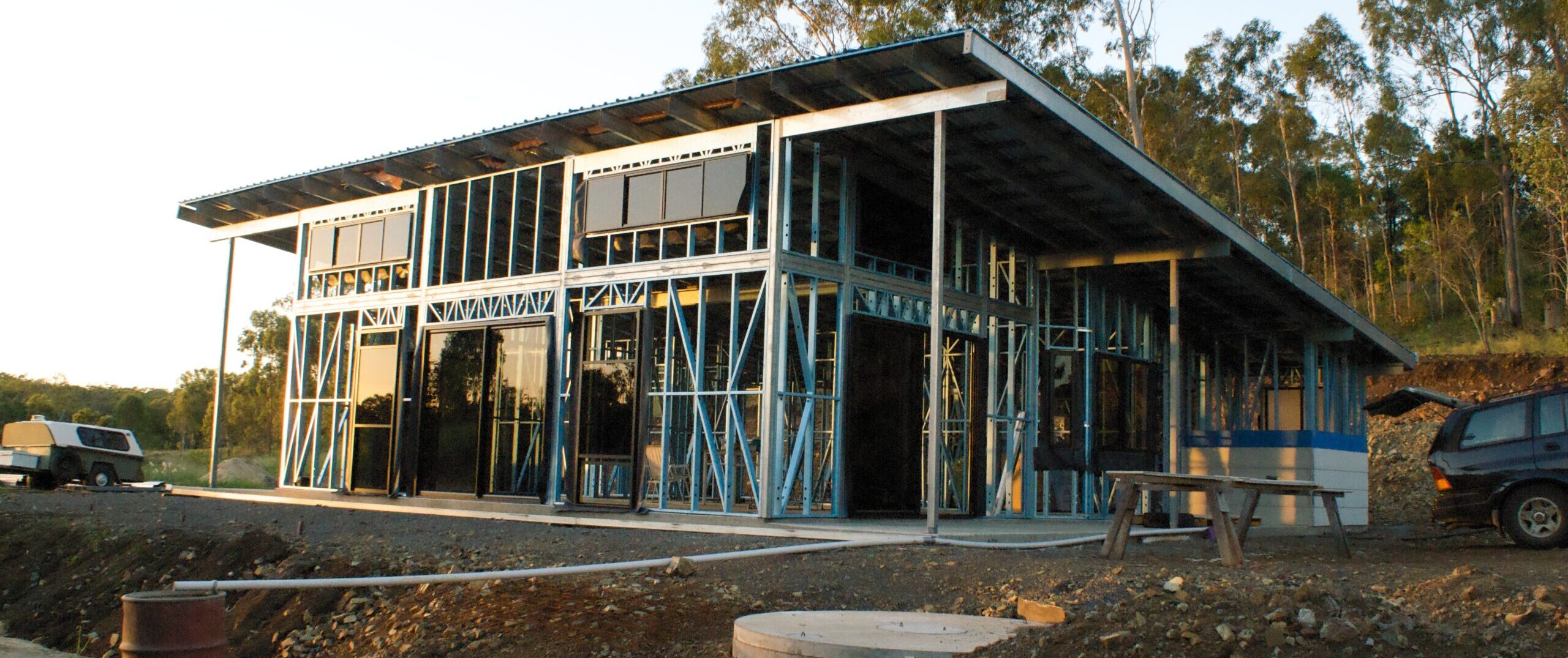

This is something I wrote in a protected post years ago. I want to get this bit out in the open....more...

One of the benefits of using jQuery as the initial framework for the Content Interface is that you can leverage the existing ecosystem. e.g. jQuery’s themes enable a default Content Interface (on the left) to be “themed” (on the right) by changing a single line of CSS....more...

As outlined previously I’m taking some steps toward learning and using the React Javascript library to develop some web interfaces/applications. The following documents progress toward writing that first application, which is largely confined to develop an initial mock-up and then learning more about the “React way”....more...

Can React.js help extend CASA support for forward-oriented design?...more...


Recently there have been various suggestions that the biggest barrier to quality online learning in higher education is lack of knowledge held by teaching staff (Johnson, 2019; Mathes, 2019; Roberts, 2018). More or better training, faculty development and requirements for formal teaching qualifications are proposed as the solution....more...
The following is a summary of the paper Theory of Workarounds....more...
At the recent ASCILITE’2019 there was a common refrain throughout the conference, which started with the original keynote as captured in the following tweet...more...
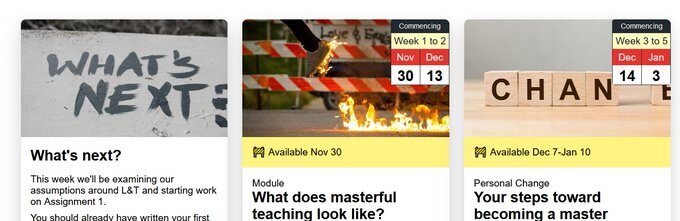
Using Blackboard Learn to design and manage a quality learning environment is hard. Managing the web content alone is hard to do well. To do so requires significant HTML, CSS and related web design knowledge. Knowledge that not everyone has, or should have, or can have. That's why there are so many ugly Blackboard sites....more...
The following has been accepted for presentation at ASCILITE'2019. It’s based on work described in earlier blog posts....more...
This post continues an on-going exploration of knowledge reuse in design for digital learning. Previous posts (one and two) started the exploration in the context of developing an assemblage to help designers of web-based learning environments create a card interface (see Figure 1). Implementing such a design from scratch requires a diverse collection of knowledge that is beyond most individuals. It is hoped that packaging that knowledge into an assemblage of technologies will allow for that knowledge to be used and reused (within Blackboard 9.1) by more people and subsequently have a positive impact on the learning environment and experience....more...
In October last year I started a new position at Griffith University. A role designed to help improve the quality and quantity of use of the institutional learning ecosystem. An ecosystem that includes Blackboard (both 9.1 and soon Ultra), Office365, PebblePad, Echo360 etc. Pretty early on it became apparent that there was some problems with reusing design knowledge. A problem that had some initial solutions. But these solutions weren't built upon. The following tells the story of those problems and how I've be playing with an old idea of scaffolding, context sensitive conglomerations (aka constructive templates) to help....more...
Following is a summary of Johanson and Hasselbring (2018) and an exploration of what, if anything, it might suggest for learning design and learning analytics. Johanson and Hasselbring (2018) explore why scientists whom have been developing software to do science (computational science) haven't been using principles and practices from software engineering to develop this software. The idea is that such an understanding will help frame advice for how computational science can be improved through application of appropriate software engineering practice (**assumption**)....more...
David Jones, Celeste Lawson, Colin Beer, Hazel Jones...more...
The following provides a collection of information and resources associated with a paper and presentation given at ALASI 2017 - the Australian Learning Analytics Summer Institute in Brisbane on 30 November, 2017. Below you'll find an abstract, a recording of a version of the presentation, the presentation slides and the references....more...
The following post contains the content from a poster designed for the 2017 USQ Toowoomba L&T celebration event. It provides some rationale for a technology demonstrator at USQ based on the Moodle Activity Viewer....more...
What follows are the resources associated with a workshop being run at the University of Southern Queensland. As the title suggests, the aim is to get USQ folk started using the Moodle Activity Viewer to explore usage of Moodle activities and resources, and to briefly introduce the idea of digital renovation....more...
"failure" (CC BY 2.0) by tinou bao...more...
The following information is taken from and adds to the contents of a poster by Alice Brown and I for a USQ L&T Celebration Event. It describes the need for a Student Evaluation of Teaching leaderboard, how it works, and the results of some early applications (12 to 15% increases in response rates in individual courses, resulting in response rates that are double the institutional average - around 50%, rather than 25%)....more...
End of semester 1 is fast approaching. One of the end of semester tasks is encouraging students in courses to complete the institutional Student Evaluation of Teaching (SET) surveys. Last year I experimented with a "SET leaderboard" (see the following image). It's a table that lists the response rates on the SET surveys for the current and previous offerings of the course ranked according to the percentage response rate....more...
I have a problem with my Student Evaluation of Teaching (SET) data!...more...
NGL is a course I teach. Participants are asked to spend the semester engaging with networked and global learning as: student, learner, and teacher. They are asked to blog and reflect on this mishmash of experiences throughout the semester. I'm trying to do this as well. Not only to model one version of expectations, but also because I find it a valuable learning process myself. I did "me as learner" last week, this week it's time for "me as teacher"....more...