The following is a collection of presentation resources (i.e. the slides) for an ASCILITE'2012 of this paper. The paper and presentation are a summary of the outcomes my PhD work. The thesis goes into much more detail....more...
In my previous academic life, I never really saw the point of book chapters as a publication form. For a variety of reasons, however, my next phase in academia appears likely to involve an increasing number of book chapters. The need for the first such chapter has arisen this week and the first draft is due by February next year, which is a timeline to give me just a little pause for thought. (There is a chance that this book might end up as a special edition of a journal)...more...
There is a definition of insanity that I've seen seen attributed to either Einstein or Benjamin Franklin,...more...
Busy being a good boy working on the thesis, currently reading a collection of literature to flesh out Chapter 2 which is drawing on the Ps Framework to illustrate the current state of e-learning within Universities. As the last post illustrates, the most recent paper I'm reading is White (2006)....more...
Yesterday I gave a presentation at the Australian National University on my PhD. I'm doing it through ANU and this 30 minute presentation is a standard requirement of study. The slides are up on slideshare (embedded below). I recorded the audio and will be trying to put that online later on today and make the slides into a slidecast....more...
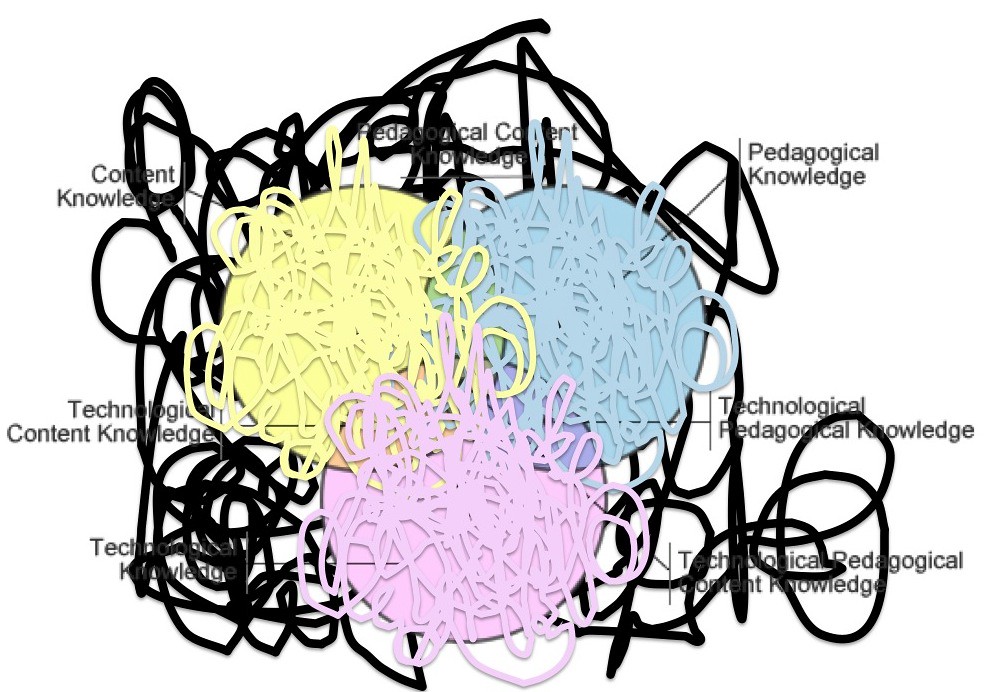
I'm a fan of frameworks and taxonomies. Also known as theories for understanding (Gregor, 2006). It's the understanding part that I like. They provide, or at least good ones do, a leg up in understanding difficult concepts. As Mischra and Koehler (2006, p 1019) say...more...
This video speaks to me on so many levels. It summarises many of the problems I have faced and encountered trying to implement innovative approaches to e-learning at universities over the last 15 plus year. I'm sure I am not alone....more...
In a recent post I started my collection of quotes on this blog. I also talked about the "mere exposure effect" and suggested it's one reason behind the horseless carriage approach to using new technology. It's also one reason why people resist new technology - especially e-learning/computer technology....more...
In a post yesterday I talked about how most applications of e-learning within universities seems to actively prevent students and staff leveraging the protean nature of information technology. That is the nature of computer software to be flexible, malleable and customisable....more...
A part of my thinking around the Ps Framework I suggest that there are a number of dominant assumptions that underpin the current implementation of e-learning within institutions of higher education. I believe these dominant assumptions limit the quality, efficiency, effectiveness and innovativness of e-learning at Universities. In this post I am trying to identify one of the dominant assumptions associated with the "Product" component of the Ps Framework and its implications....more...
The very idea of "best practice" is silly. In any meaningful complex activity the idea of simply copying what someone else did is destined to fail because it doesn't seek to understand the reasons why that best practice worked for them and what are the differences between "them" and "us"....more...
The title to this post is included in a quote from Kane, Sandretto and Heath (2004)...more...
All over the place there are people in organisations performing evaluations and comparisons of competing information systems products with a strong belief that they are being rational and objective. Since the late 1990s or so, most Universities seem to be doing this every 5 or so years around learning management systems. The problem is that these processes are never rational or objective because the nature of human beings is such that they never can be (perhaps very rarely - e.g. when I'm doing it ;) )....more...
This article from a Training industry magazine raises a number of issues, well known in the research literature, about the significant limitations that exist with the evaluation of university teaching....more...
The following is forming up as something to go into my thesis as part of the "Past experience" component of the Ps Framework....more...
16 September, 2012 - for some reason today has seen a fair bit of interest in this post from over 3 years ago. I though I'd take the opportunity to move this particular argument up a level....more...
In a previous post I pointed to and summarised a working paper that suggests that IS research is not all that diverse. At least at the conceptual level....more...
This post contains a link to a PDF working paper that uses metaphor analysis on a collection of journal papers to examine just how diverse research within the Information Systems field actually is. It finds that the IS field is actually not very diverse at all from this perspective, which is somewhat contradictory to what is accepted by most IS folk....more...
I've been a fan of Dave Snowden and his work for a couple of years. In this blog post from last year Dave shares 7 principles for "rendering knowledge". For me, these 7 principles have direct connection with the tasks I'm currently involved with e-learning, curriculum design and helping improve the quality of learning and teaching....more...
!!! warning "Broken image link"...more...
The following quote is from (Hirschheim, 1992) and is questioning the practice of research/the scientific method...more...
Friday I am supposed to be giving a 30 minute overview of the PLEs@CQUni project. The tentative title is "PLEs@CQUni: Origins, Rationale, Outcomes and Future?". As part of the origins section I was going to talk about some of the fundamental assumptions of university learning and teaching which PLEs, learning 2.0 and associated concepts, memes and propaganda are undermining, or at least questioning. The following is an attempt to outline some of those and hopefully a plea for the perspective of others....more...
Yesterday I attended a session by George Siemens with the title "Extending the classroom: Open content and open teaching". The presentation was video-conferenced from the Sunshine Coast to a range of locations across Australia. I was in a room at CQUniversity in Rockhampton with quite a number of folk. What follows are my reflections on that talk....more...
For those of you who don't know, I'm developing something called the Ps Framework for sensemaking around e-learning (read the earlier post for more information....more...
The Ps Framework is a taxonomy/framework that has arisen out of my attempts to understand the literature around e-learning within universities. It's main aim is to serve as the structure for chapter 2 of my thesis. This blog post seeks to summarise some of the origins and potential futures of the Ps framework and also to explain why I think it might be useful....more...
The PLEs@CQUni project is attempting to figure out how/if social software, web 2.0 etc can be effectively used at CQUni to improve learning and teaching. I'm part of a group attempting to figure out how we can do this, figure out what works, what doesn't and get these technologies/ideas used effectively....more...
Yesterday I gave a presentation at CQU titled "The Ps Framework: Mapping the landscape for the PLEs@CQUni project". The slides are on Slideshare and the video on Google video and are embedded below....more...
As I've mentioned before Myers-Briggs puts me into the INTP box, a Kiersey Archiect-Rational. Which amongst many other things I have an interest in figuring out the structure of things....more...
Time to bang on again about the "product fad" that is course management systems and higher education....more...
As part of the missing Ps framework, in the "People" category, I'm planning to talk about how the decision making around adoption of course management systems (CMSs) is always posited as a rational act. When, in fact, most people involved in and the decision making processes around CMSs is far from rational....more...
The Economist magazine ran an article on Dec 19th, 2006 which is sub-titled - "Consumer technologies are invading corporate computing"....more...
It's been quiet on the blog front for the last couple of weeks as I've been busy putting the finishing touches on the missing Ps presentation. The presentation was given on Friday the 24th November, 2006....more...
The work on the missing Ps is intended to contribute some research publications within the information systems field and also form the structure for chapter 2 of my PhD thesis. Consequently, it is important that the work have a good research foundation. This post is intended to provide that foundation, or at least document my development of the foundation....more...
The Missing Ps framework is my attempt to generate a way of identifying the flaws in the methods used by Universities to select an LMS....more...
LMS adoption decisions are made by people. LMSes are used by people. The nature of those people who they are, how they think and what they believe, amongst other characteristics, have a significant impact....more...
While elearning is still relatively new there has been significant levels of implementation and research around elearning. It seems fairly obvious that any LMS adoption process should make use of the knowledge generated by this past experience....more...
A continuation of the elements of the "missing Ps"....more...
The Missing Ps framework is my attempt to generate a way of identifying the flaws in the methods used by Universities to select an LMS....more...
The Missing Ps framework is my attempt to generate a way of identifying the flaws in the methods used by Universities to select an LMS....more...
The missing Ps framework is very much under construction attempt to identify the holes and flaws in the methods used by Universities to evaluate and select a learning management system (LMS)....more...
For, what seems the longest time, CQU has been talking about the need to evaluate and choose yet another LMS. We've sort of done this two times before, and from my perspective, both adoption decisions have been fatally flawed. Some discussion about those processes can be found, to a lesser or greater extent, in a variety of publications by CQU authors including: Danaher, Luck and McConachie (2005), Sturgess and Nouwens (2005), and Jones, Luck, McConachie and Danaher (2005)...more...